
Gadi Eisenkot tasked with forming Israeli government after deadlocked election
Former military chief Gadi Eisenkot received a mandate from President Isaac Herzog to build a coalition following the 27 October vote that left both him and Benjamin Netanyahu short of a majority.
By LAS News Desk · Published 8 Nov 2026, 19:17 WAT
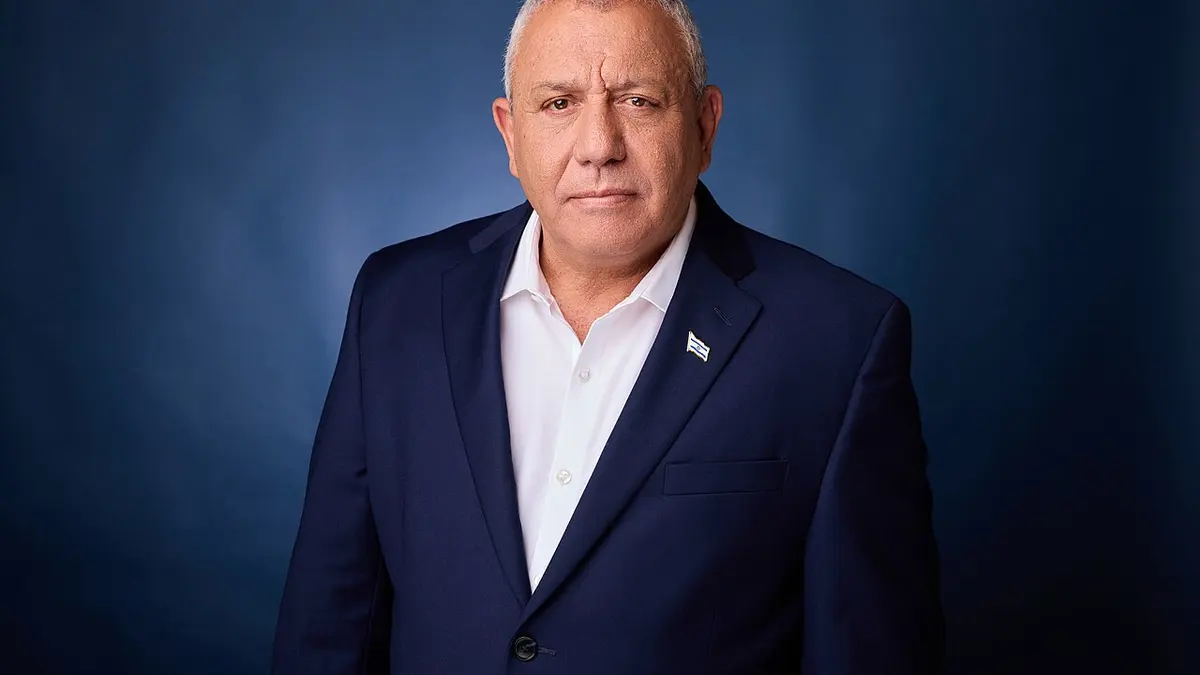
Former Israeli military chief Gadi Eisenkot was handed the first mandate to form a new government on 8 November, after President Isaac Herzog invited him to the presidential residence. The appointment follows the 27 October parliamentary election, which left both Eisenkot and incumbent Prime Minister Benjamin Netanyahu without the 61 seats needed for a majority in the 120‑member Knesset.
According to Yashar party head Eisenkot, he intends to move swiftly to assemble a broad-based administration, characterizing the endeavor as exceptionally difficult while calling for innovative and non-traditional political measures. He framed the situation as a national emergency, citing threats from Iran, the need for progress toward peace in Gaza and ongoing negotiations with Lebanon and other neighbours.
Background
The October 27 election saw Netanyahu’s religious‑nationalist bloc lose its majority for the first time in decades, though it remained the largest single bloc in the Knesset. Eisenkot, a former chief of staff of the Israel Defence Forces, emerged as Netanyahu’s strongest rival. President Herzog, whose role is largely ceremonial, formally nominated Eisenkot on 7 November, triggering a 28‑day period—extendable by 14 days—for coalition talks.
Eisenkot has identified three possible paths to securing a legislative majority: establishing a minority cabinet dependent on Arab factions for critical votes, negotiating a coalition with ultra-Orthodox groups previously shunned by him and his supporters, or forming a joint administration with Netanyahu. All three options face significant obstacles, according to analysts cited in the sources.
Why it matters
The deadlock affects Israel’s ability to address pressing security concerns, including the perceived threat of an Iranian attack and the ongoing conflict in Gaza. A stable government is also needed to advance negotiations with Lebanon and other regional neighbours. The conditions Eisenkot has set for any potential coalition involve acknowledging Israel's status as a Jewish and democratic nation, implementing mandatory national service to strengthen the armed forces, and maintaining a strict position against Hamas, which he views as a terrorist entity.
The outcome will determine which parties hold sway over defence, foreign policy and domestic reforms. If Eisenkot succeeds, his coalition could shift Israel’s approach to Arab parties and ultra‑Orthodox factions. Failure would allow Netanyahu another chance to form a government, or open the field to a third candidate, prolonging the political impasse.
What happens next
Eisenkot now has 28 days to negotiate a coalition, with a possible 14‑day extension if needed. Should he be unable to secure a majority, the mandate will pass to another candidate, and the process could repeat until a government is formed or new elections are called. Analysts note that all three of Eisenkot’s proposed pathways are considered unlikely, suggesting that further negotiations and possibly a unity arrangement may be required to break the stalemate.
Sources
- Netanyahu rival Eisenkot seeks 'wide' government but path to power uncertain — Al-Monitor
- Netanyahu rival Eisenkot seeks 'wide' government but path to power uncertain — Straits Times World
- Israeli President picks Gadi Eisenkot, Netanyahu rival, to try to form government — Hindu World
- Israeli president picks Netanyahu's rival Eisenkot to try to form government — France 24 Middle East
Spotted an error? Report a correction · Corrections policy
Related stories
President Herzog to decide who will form Israel’s new government
Israeli President Isaac Herzog will announce on Sunday who will try to build a new cabinet after the October 27 election left no clear majority. Gadi Eisenkot received 67 recommendations, while Benjamin Netanyahu got 46, with seven abstentions.
Photo: יהב טרודלר (Yahav Trudler - Yahav Studio) / Wikimedia Commons · CC BY-SA 3.0
LAS News Desk · 7 Nov 2026, 08:08 WAT · 12 sources

Israeli President Herzog assigns opposition leader Gadi Eisenkot mandate to build new coalition
President Isaac Herzog has given Gadi Eisenkot, head of the centrist Yashar party, up to six weeks to form a government that could replace Benjamin Netanyahu’s current administration, amid complex coalition talks.
Photo: Suresh Babunair / Wikimedia · CC BY 3.0
LAS News Desk · 8 Nov 2026, 19:46 WAT · 9 sources
Iran dismisses Israeli election outcome as irrelevant amid heightened threats from Netanyahu
Iran's foreign ministry said the result of Israel's October 27 parliamentary vote will not affect Tehran, while Israeli Prime Minister Benjamin Netanyahu warned Iran and its proxies against any attempts to disrupt the election.
LAS News Desk · 26 Oct 2026, 11:16 WAT · 7 sources
Trump publicly backs Netanyahu ahead of Israel’s October 27 election
U.S. President Donald Trump has issued a full endorsement of Israeli Prime Minister Benjamin Netanyahu, arriving just weeks before Israel’s parliamentary vote. The move comes amid a tight race and a backdrop of recent conflict with Iran and the Hamas attack.
Photo: The White House / Wikimedia Commons · Public domain
LAS News Desk · 19 Oct 2026, 03:15 WAT · 6 sources

Netanyahu alleges foreign funding in Israeli election, Arab bloc denies claims
Israeli Prime Minister Benjamin Netanyahu has accused foreign states of spending significant sums to influence the recent parliamentary vote. The Joint List, the largest Arab-Israeli bloc, rejected the allegations as political persecution.
LAS News Desk · 6 Nov 2026, 08:47 WAT · 1 source
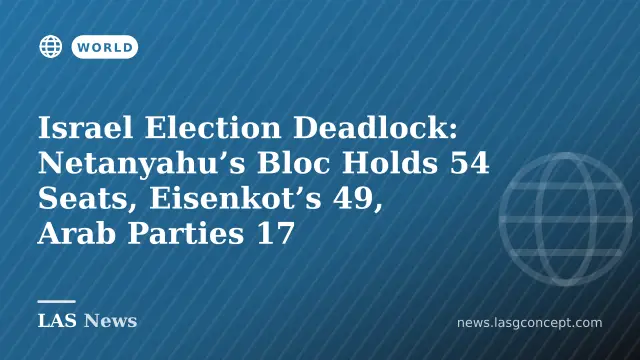
Israel election results show no clear winner as Arab parties emerge as potential kingmakers
Partial counts from Israel's 2026 election indicate neither Benjamin Netanyahu nor Gadi Eisenkot has secured a majority, while Arab parties have performed strongly enough to influence coalition talks, prompting accusations from Likud of election theft.
LAS News Desk · 29 Oct 2026, 02:15 WAT · 9 sources
More World news ›
- Nvidia launches internal probe after CEO Jensen Huang admits affair with woman alleged to be Chinese spy
- New Zealand election results leave parliament split, coalition talks likely
- At least five killed in Krakow shooting and 21 dead in Senegal migrant boat disaster reported
- Cisco expands contracts with Israeli military amid internal protests during Gaza conflict
- Explosions near Qeshm Island and vessel strikes raise tensions in Strait of Hormuz