
World Bank reports developing nations' external debt reaches record $9.4 trillion in 2025
The World Bank’s International Debt Report 2026 shows external debt of low‑ and middle‑income countries rose 5.5% to $9.4 trillion, driven by private borrowing and higher interest rates, raising concerns over fiscal pressure especially for the poorest economies.
By LAS News Desk · Published 5 Nov 2026, 16:15 WAT
Developing countries’ external debt climbed to a record $9.4 trillion in 2025, according to the World Bank’s International Debt Report 2026 released on 5 November 2026. The increase of 5.Growth accelerated to 5%, marking the swiftest pace observed since 2021 and approximately quadrupling the mean expansion seen from 2022 through 2024. This acceleration stemmed from increased borrowing from private lenders and restored entry into global bond markets, causing public sector bond issuance to jump nearly 35% to $251 billion, a five-year peak.
The report highlighted that the rise placed considerable strain on public finances, especially in the poorest nations. Nations qualifying for concessional loans from the World Bank’s International Development Association (IDA) experienced an 8% rise in external debt.1% to $1.3 trillion. The World Bank’s chief statistician, Haishan Fu, noted that while the return of private lending is welcome, it comes with higher borrowing costs and reduced resources for long‑term development.
Background
The International Debt Report 2026 builds on earlier annual assessments that track external liabilities of low‑ and middle‑income economies. The 2025 figures represent the steepest year‑on‑year rise since 2021, a period when global financial markets began reopening to emerging economies after pandemic‑related tightening. Private lenders made up a substantial portion of this growth, indicating a recovery of trust in these financial sectors. In addition to bond issuance, public entities accessed private‑creditor financing, contributing to the overall debt expansion.
For IDA‑eligible countries, the average interest rate on new private‑creditor commitments reached 8.2% in 2025 – the highest level since 1989. New bonds issued by these economies carried an average rate of 9.4%. By contrast, countries borrowing on non‑concessional terms paid an average of 5.5% on new bonds, down slightly from 5.8% previously. The interest rate disparity between private and official lenders for IDA-qualifying countries expanded from 3.4 percentage points in 2016 to 5.5 points in 2025.
Nigeria, a notable IDA borrower, owed the agency about $19.12 billion as of 30 June 2026, according to the Debt Management Office. In total, low- and middle-income economies disbursed $1.4 trillion in principal and interest payments during 2025, representing a 1.9% increase and the fifth consecutive year of rising debt‑service costs.
Why it matters
The record level of external debt and the accompanying rise in interest rates have direct implications for fiscal space in developing economies. Higher debt‑service obligations reduce the amount of resources available for essential development investments such as health, education and infrastructure. The World Bank warned that mounting costs could leave governments with fewer options to fund these priorities.
The steep interest rates, especially for IDA‑eligible countries, exacerbate the challenge. An average 8.2% rate on private‑creditor commitments and 9.4% on new bonds represent the highest borrowing costs in decades, increasing the burden on already vulnerable budgets. The widening spread between private and official creditor rates indicates that concessional financing is becoming relatively cheaper, but the overall debt load continues to grow.
Stakeholders, including donor nations and multilateral institutions, are watching the figures closely. The United Kingdom, for example, announced plans to champion a “new drive on debt” during its upcoming G20 presidency, linking the initiative to broader development and historical justice concerns.
What happens next
The World Bank’s International Debt Report 2026 calls for heightened monitoring of debt sustainability and urges policy measures to mitigate rising borrowing costs. While the report does not specify concrete actions, it highlights the need for coordinated international efforts to address debt‑service pressures. The UK’s forthcoming G20 agenda may include discussions on debt relief and financing reforms, reflecting the growing attention to the issue among major economies.
The data also suggest that future reports will continue to track the evolution of private‑creditor involvement and interest‑rate trends, providing a basis for policy responses aimed at preserving fiscal space for development.
Sources
- Developing countries’ external debt hits record $9.4tn — World Bank — Punch
- World Bank raises alarm as developing countries’ external debt hit record $9.4 trillion — Nairametrics
- Nigeria, Others Pay Highest Interest Since 1989 Amid $9.4trn Debt—World Bank — Leadership
- Debt of poorest countries at record $9.4tn high, World Bank data shows — The Guardian
Spotted an error? Report a correction · Corrections policy
Related stories
Nigeria disputes World Bank's half‑year debt‑service ratio, cites data gaps
Nigeria's finance ministry rejected the World Bank's claim that interest payments in the first half of 2026 equaled 124% of federal revenue, arguing the calculation mixes federal and state obligations and omits pending receipts, while noting faster revenue growth than debt costs.
LAS News Desk · 19 Oct 2026, 08:45 WAT · 2 sources
IMF and UK officials warn of rising debt costs and cyber‑fraud risks as developing nations face financing squeeze
The International Monetary Fund and senior UK officials highlighted growing pressures from higher government borrowing costs and cyber‑attack threats, while Foreign Secretary Ed Miliband called for a new global deal to ease debt burdens on developing countries.
LAS News Desk · 14 Oct 2026, 07:46 WAT · 2 sources
Atiku urges Senate to reject Tinubu's $7.7bn loan request, citing lack of project details and rising debt
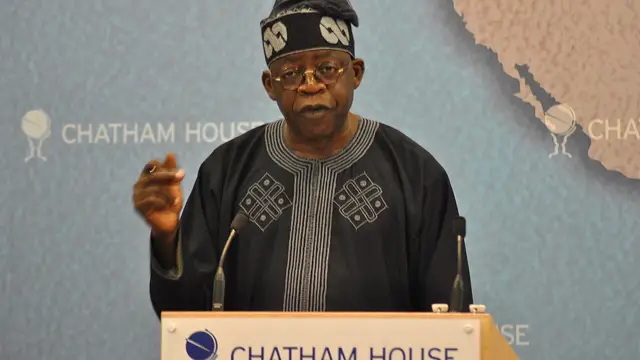
Former Vice President Atiku Abubakar called on the Senate to refuse President Bola Tinubu’s request for a $7.7 billion external loan, warning that the borrowing adds to Nigeria’s debt burden without clear project allocations.
Photo: Chatham House / Wikimedia Commons · CC BY 2.0
LAS News Desk · 4 Nov 2026, 22:15 WAT · 8 sources

Federal High Court upholds UBA's receiver appointment in N156bn Stallion Group debt case
The Lagos Federal High Court confirmed United Bank for Africa's right to enforce mortgage securities and appointed a receiver to recover an alleged N156.03 billion owed by the Stallion Group, also restricting the conglomerate from diverting government payments.
LAS News Desk · 17 Oct 2026, 04:15 WAT · 2 sources

Nigeria's FX demand soars to 15‑year high as services and financial flows dominate
Nigeria’s foreign‑exchange utilisation rose to $18.34 bn in Q2 2026, the highest level in 15 years, driven by a surge in services and financial transactions that now account for more than half of total demand.
LAS News Desk · 16 Oct 2026, 02:15 WAT · 2 sources
Pound reaches strongest level since 2016 ahead of first Bank of England rate hike in three years
Sterling has hit its highest value against a basket of currencies since the Brexit vote, coinciding with the UK government's first interest rate increase in over three years.
LAS News Desk · 5 Nov 2026, 11:16 WAT · 1 source
More Africa/Nigeria news ›
- NDC and SDP condemn court ruling that nullifies David Mark-led ADC leadership
- Nigeria President Tinubu urges Flamingos to win historic U-17 Women's World Cup final
- Peter Obi blames APC for court ruling invalidating ADC leadership
- British doctor who contracted Ebola in DR Congo transferred to London’s Royal Free Hospital
- Abia PDP endorses Tinubu for 2027 as APC launches state campaign council