
Nigeria disputes World Bank's half‑year debt‑service ratio, cites data gaps
Nigeria's finance ministry rejected the World Bank's claim that interest payments in the first half of 2026 equaled 124% of federal revenue, arguing the calculation mixes federal and state obligations and omits pending receipts, while noting faster revenue growth than debt costs.
By LAS News Desk · Published 19 Oct 2026, 08:45 WAT
Background The World Bank’s recent Nigeria Development Update highlighted a debt‑service‑to‑revenue ratio of 124 percent for the first six months of 2026, based on interest payments of about N7.7 trillion. The report suggested that such a level could threaten the country’s debt sustainability.
Government response Nigeria’s Ministry of Finance issued a statement contesting the World Bank’s figures. According to the ministry, the ratio is misleading because it combines debt that the federal government services on behalf of state authorities with federal revenue alone. The ministry also pointed out that the revenue figure used by the bank excludes income already earned by government agencies and enterprises but not yet transferred to the treasury, and that statutory tax schedules mean a substantial portion of revenue is collected in the second half of the year. These factors, the ministry argued, render a first‑half comparison incomplete.
Fiscal trends Data released by the finance ministry indicate that federal revenue rose by roughly 72 percent between the first half of 2025 and the same period in 2026, increasing from N3.6 trillion to N6.2 trillion. In the same interval, interest payments grew by about 38 percent, from N5.6 trillion to N7.7 trillion. Consequently, revenue is expanding at almost twice the pace of debt‑service costs. The ministry noted that the interest‑to‑revenue ratio therefore fell by 32 percentage points over the year, moving from 156 percent in H1 2025 to 124 percent in H1 2026, while the absolute gap between interest and revenue narrowed from N2.0 trillion to N1.5 trillion.
Wider context The ministry cited the full‑year 2025 debt‑service‑to‑revenue ratio, which fell below 60 percent after earlier reforms, as evidence of improving fiscal health. It attributed the recent decline in the ratio to the administration’s reform agenda, which it says has boosted revenue collection and moderated debt‑service pressures.
Diverging assessments While the World Bank’s update focuses on the headline ratio and its implications for debt sustainability, the Nigerian government emphasizes methodological differences and recent fiscal improvements. Both sources agree that interest payments remain substantial, but they differ on how the figures should be interpreted relative to revenue.
Outlook The disagreement underscores the challenges of measuring debt sustainability in a context where federal and sub‑national finances intersect. Ongoing monitoring by both the World Bank and Nigerian authorities will be needed to assess whether the reported improvements translate into longer‑term fiscal stability.
Sources
Spotted an error? Report a correction · Corrections policy
More in Africa/Nigeria

UN lauds Nigeria’s solar electrification project that reaches five million households
The United Nations highlighted Nigeria’s rural electrification programme, which has supplied electricity to more than five million people through solar mini‑grids and home systems, as a model for affordable energy access in developing countries.
LAS News Desk · 19 Oct 2026, 09:45 WAT · 1 source

APC Presidential Campaign Council convenes inaugural meeting and starts outreach to traditional rulers ahead of 2027 elections
The All Progressives Congress Presidential Campaign Council held its first meeting in Abuja on 20 October 2026 and, days later, its director‑general visited the Ooni of Ife and the Emir of Ilorin to seek blessings, signalling the start of a nationwide consultative tour before the 2027 polls.
LAS News Desk · 19 Oct 2026, 09:45 WAT · 3 sources
Ogun Igbo group backs Tinubu and Yayi for 2027 polls
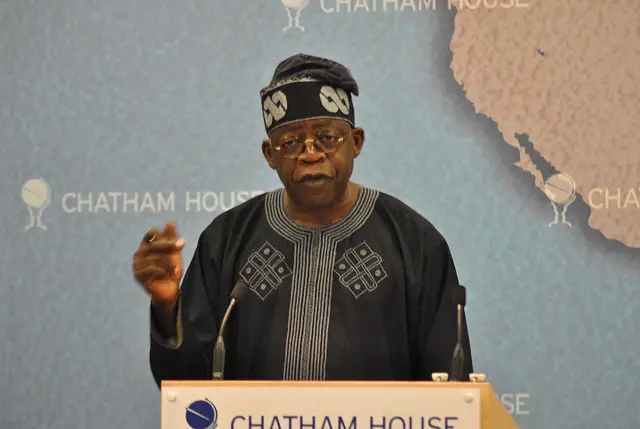
The Ohanaeze Ndi Igbo in Ogun State has pledged support for President Bola Tinubu and Senator Solomon Adeola (Yayi) in the 2027 elections, awarding the senator a chieftaincy title for his development work.
LAS News Desk · 19 Oct 2026, 09:15 WAT · 1 source