
Israeli opposition leader Gadi Eisenkot invites Likud to marathon coalition talks as deadline looms
Centrist Yashar party chair Gadi Eisenkot has called caretaker Prime Minister Benjamin Netanyahu’s Likud party to a series of coalition negotiations starting 22 November, seeking the broadest possible government before his December deadline.
By LAS News Desk · Published 22 Nov 2026, 10:47 WAT
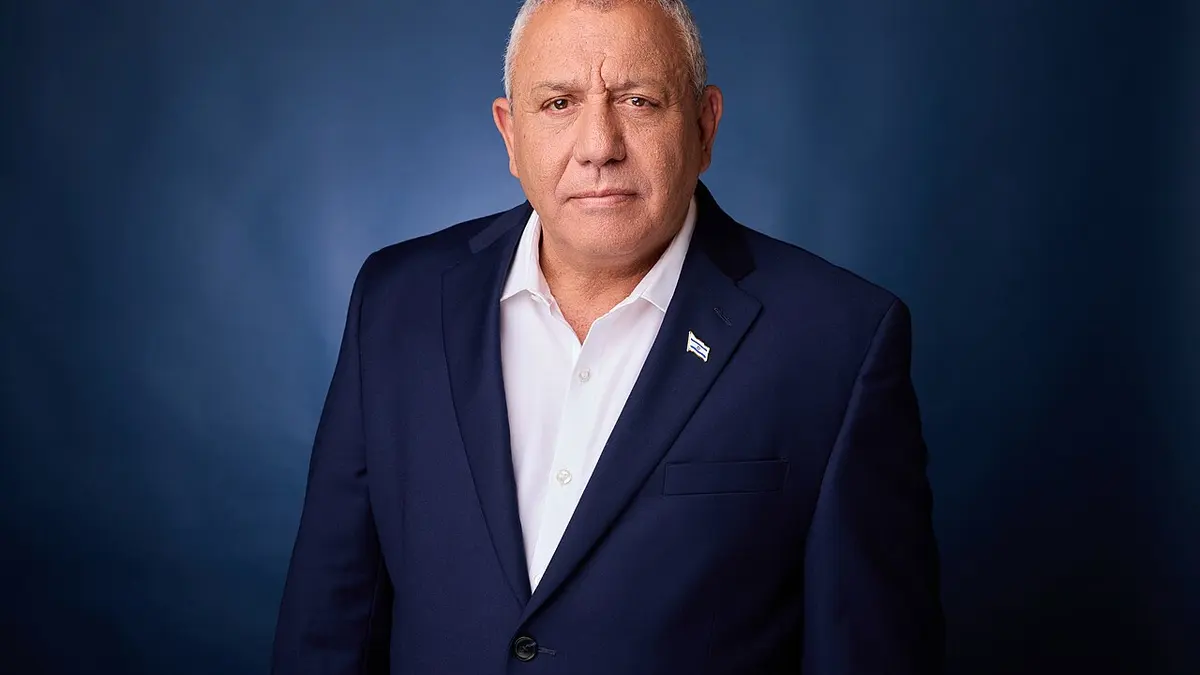
Gadi Eisenkot, the newly appointed head of Israel’s Yashar party and former military chief, announced on 21 November that his party would invite the right‑wing Likud bloc, led by caretaker Prime Minister Benjamin Netanyahu, to a marathon series of coalition talks. According to Yashar, talks are scheduled to start on 22 November, which he characterizes as a sincere dedication to assembling the largest possible cabinet. Eisenkot has been given until early December to assemble a new cabinet after the October legislative election left both his centrist bloc and Netanyahu’s Likud bloc short of a majority.
The invitation comes amid intense internal debate within Eisenkot’s camp about which partners to include. While some members argue for cooperation with ultra‑Orthodox parties or Arab‑majority lists, others, including former prime minister Naftali Bennett, advocate for a "Zionist unity government" headed by Eisenkot that would exclude Netanyahu’s bloc altogether. Netanyahu, for his part, has been pressing for a national unity arrangement that he says is essential for Israel’s security.
Background
Israel’s 2026 parliamentary election, held in October, produced a fragmented Knesset with no clear winner. Both the Yashar party, positioned in the centre, and the right‑wing Likud party failed to secure the 61 seats needed for a majority. Under Israeli law, the president tasked Eisenkot, as the leader of the largest opposition bloc, with forming a new government. He was given a deadline of early December, roughly a month after the election, to present a viable coalition.
Eisenkot’s Yashar party has framed its approach as inclusive, seeking to explore every possible alliance. In a declaration, the party noted that extending an invitation to Likud was intended to explore all avenues for establishing a new administration, describing the discussions as an extensive marathon designed to exhaust every potential option. Naftali Bennett, the former head of government and a central player in Eisenkot’s movement against Netanyahu, has openly advocated for a Zionist unity cabinet led by Eisenkot, while vowing that his faction would refuse to participate in any alliance containing Netanyahu.
At the same time, Likud has indicated its readiness to negotiate a unity pact, provided that the final deal omits Arab political groups and steers clear of personal insults or inflammatory rhetoric. The party’s stance reflects Netanyahu’s broader push for a national unity government that he argues is needed to safeguard Israel amid regional tensions.
Why it matters
The outcome of these talks will determine the composition of Israel’s next government and, consequently, the country’s policy direction on security, the economy, and social issues. A coalition that includes ultra‑Orthodox parties could affect budget allocations for religious institutions and influence legislation on public observance. Conversely, an alliance with Arab‑majority lists could shift the balance on minority rights and the peace process.
Stakeholders across the political spectrum are watching closely. Netanyahu’s Likud bloc seeks to retain influence and possibly keep Netanyahu in power, while Eisenkot’s Yashar party aims to demonstrate its capacity to lead a broad coalition. Bennett’s refusal to cooperate with Netanyahu adds another layer of complexity, potentially limiting the pool of viable partners.
International observers note that Israel’s political stability is crucial for regional security, especially given ongoing conflicts in neighbouring areas. A delayed or failed coalition could lead to prolonged caretaker governance, affecting diplomatic negotiations and defence coordination.
What happens next
The marathon talks are scheduled to start on 22 November and are expected to continue over several days, with both sides indicating a willingness to negotiate but also setting clear red lines. Eisenkot has indicated he will consider all options, including partnerships with ultra‑Orthodox or Arab parties, but has not ruled out a national unity arrangement with Likud. Netanyahu has reiterated his demand for a unity government that excludes Arab parties and avoids personal attacks.
Both parties have pledged to keep the public informed of any breakthroughs. If Eisenkot succeeds in forming a coalition before the early‑December deadline, the new government will be presented to the Knesset for a confidence vote. Failure to do so could trigger another election or lead the president to assign the mandate to another political figure.
The negotiations will therefore shape Israel’s immediate political future, with implications for domestic policy and regional dynamics.
Sources
- Gadi Eisenkot invites Netanyahu's Likud party for 'marathon' coalition talks — Euronews
- Gadi Eisenkot invites Netanyahu’s party for Israeli coalition talks — Straits Times World
- Eisenkot invites Netanyahu’s party for Israeli coalition talks — Hindu World
- Eisenkot invites Netanyahu’s party for ‘marathon’ Israeli coalition talks — France 24
- Eisenkot invites Netanyahu's party to coalition talks — RTE
Spotted an error? · Corrections policy
Related stories
Israel's new Knesset sworn in as Gadi Eisenkot begins coalition talks to replace caretaker Netanyahu
The 120‑member Israeli parliament convened on 10 November 2026 after an inconclusive October election, with opposition leader Gadi Eisenkot tasked by President Isaac Herzog to form a government within 28 days.
Photo: יהב טרודלר (Yahav Trudler - Yahav Studio) / Wikimedia Commons · CC BY-SA 3.0
LAS News Desk · 10 Nov 2026, 21:45 WAT · 9 sources

Israeli President Herzog assigns opposition leader Gadi Eisenkot mandate to build new coalition
President Isaac Herzog has given Gadi Eisenkot, head of the centrist Yashar party, up to six weeks to form a government that could replace Benjamin Netanyahu’s current administration, amid complex coalition talks.
Photo: Suresh Babunair / Wikimedia · CC BY 3.0
LAS News Desk · 8 Nov 2026, 19:46 WAT · 9 sources
President Herzog to decide who will form Israel’s new government
Israeli President Isaac Herzog will announce on Sunday who will try to build a new cabinet after the October 27 election left no clear majority. Gadi Eisenkot received 67 recommendations, while Benjamin Netanyahu got 46, with seven abstentions.
Photo: יהב טרודלר (Yahav Trudler - Yahav Studio) / Wikimedia Commons · CC BY-SA 3.0
LAS News Desk · 7 Nov 2026, 08:08 WAT · 12 sources
Matan Kahana elected Knesset speaker with 66 votes, signalling shift away from Netanyahu's agenda
Israel's parliament chose Matan Kahana as speaker on 18 November 2026, backed by opposition and Arab parties, a move seen as a step toward reversing policies of the outgoing Netanyahu government.
LAS News Desk · 18 Nov 2026, 08:16 WAT · 9 sources
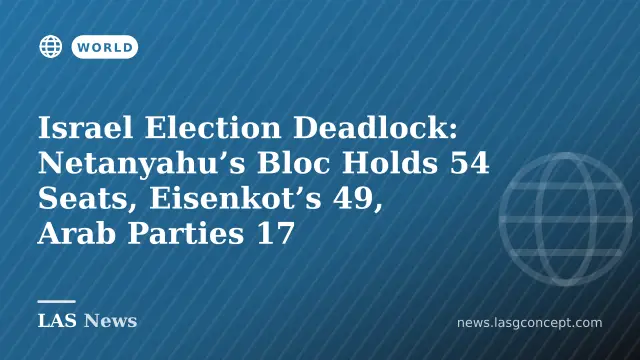
Israel election results show no clear winner as Arab parties emerge as potential kingmakers
Partial counts from Israel's 2026 election indicate neither Benjamin Netanyahu nor Gadi Eisenkot has secured a majority, while Arab parties have performed strongly enough to influence coalition talks, prompting accusations from Likud of election theft.
LAS News Desk · 29 Oct 2026, 02:15 WAT · 9 sources
Trump publicly backs Netanyahu ahead of Israel’s October 27 election
U.S. President Donald Trump has issued a full endorsement of Israeli Prime Minister Benjamin Netanyahu, arriving just weeks before Israel’s parliamentary vote. The move comes amid a tight race and a backdrop of recent conflict with Iran and the Hamas attack.
Photo: The White House / Wikimedia Commons · Public domain
LAS News Desk · 19 Oct 2026, 03:15 WAT · 6 sources
More World news ›
- Iran attacks trigger fire at Bahrain industrial site and strike US bases as tankers hit in Hormuz
- Three dead and 36 missing after fire engulfs confectionery factory near Jakarta
- US Central Command refutes Iranian claim of missile strike on F-16 in Gulf
- Israeli strike on Gaza vehicle distributing food kills three, civil defence says four dead overall
- South Korean education minister resigns after AI‑assisted cheating scandal erupts ahead of university entrance exam