
Nigeria targets single-digit inflation by 2027 despite rising lending rates
Finance Minister Taiwo Oyedele announced a goal to bring inflation below 10 percent by late 2027, aiming to lower borrowing costs, even as average lending rates increased to 32.62 percent in September.
By LAS News Desk · Published 27 Oct 2026, 04:46 WAT
The Nigerian federal government has set a target to reduce headline inflation to single digits before the end of 2027. Finance Minister and Coordinating Minister of the Economy, Taiwo Oyedele, announced this objective on Monday, October 26, 2026, during the 32nd Nigerian Economic Summit held at the Transcorp Hilton in Abuja. The primary aim of this policy direction is to create conditions for lower interest rates, which the minister argued would unlock investment and accelerate economic growth. Oyedele noted that while the country is currently growing at a rate of 4.43 percent, the high cost of borrowing, which is close to 30 percent, limits the potential for expansion. He suggested that achieving single-digit borrowing rates would significantly improve the economic outlook.
Background
The announcement comes against a backdrop of recent monetary policy adjustments and shifting inflation trends. The Central Bank of Nigeria (CBN) reduced its benchmark monetary policy rate to 23 percent in September 2026. Notwithstanding this relaxation, the mean ceiling interest rate for bank loans climbed to 32.62 percent during September, marking an increase from 29.20 percent in August. In a parallel trend, the standard prime borrowing rate moved upward from 17.86 percent in the previous month of August to reach 19.04 percent by September. This divergence highlights the slow transmission of monetary easing to the real economy, where banks price loans based on funding costs, creditworthiness, and operating expenses. High yields on government securities also make private lending less attractive for financial institutions.
Inflation figures show a gradual decline, with headline inflation falling to 14.63 percent in September 2026 from 15.39 percent in August. This marks the fourth consecutive monthly decrease in price pressures. However, food inflation remains a significant challenge, standing at 19.59 percent. To meet the government’s target of 9.9 percent, headline inflation must decrease by another 4.73 percentage points from the September level. Achieving this goal demands persistent price stabilization within an economic landscape where expenditures on food, power, and transportation continue to exert significant upward pressure. Oyedele supported the administration's structural adjustments, explaining that funds saved via currency and fuel subsidy changes are now being used to aid residents by boosting wages, settling overdue pension debts, and offering low-cost loans to small enterprises. He argued that the benefits of these reforms are already reaching ordinary Nigerians, even as the administration focuses on accelerating broader growth.
Why it matters
The push for single-digit inflation is intended to lower the cost of capital for businesses and improve public finances. If successful, cheaper credit could stimulate investment and boost economic activity. However, the current trajectory of lending rates poses a challenge to this goal. The rise in maximum lending rates despite the central bank’s rate cut indicates that businesses may continue to face expensive borrowing costs in the near term. The International Monetary Fund (IMF) has previously described this situation, where policy rates fall but lending rates rise, as a key issue in the Nigerian economy. The disparity between the declining headline inflation and the rising cost of borrowing suggests that the path to single-digit interest rates is complex and may not follow a linear trajectory. The government’s strategy relies on sustained disinflation to eventually allow for further rate cuts that banks will be willing to pass on to borrowers.
What happens next
The government has not specified the precise measures or detailed timeline for bringing inflation down from its current level to the single-digit range. The target is set for before the end of 2027, but the specific policy levers to be used beyond the current reform framework remain to be detailed. The focus will likely remain on maintaining price stability to create the necessary conditions for the central bank to continue easing monetary policy, which in turn should help align lending rates with the government’s growth objectives.
Sources
Spotted an error? Report a correction · Corrections policy
Related stories
Nigeria's headline inflation eases to 14.6% in September as energy costs jump
The National Bureau of Statistics reported a fall in overall inflation to 14.63% in September 2026, the fourth consecutive monthly decline, while energy inflation more than doubled to 10.85% and food prices remained high.
LAS News Desk · 15 Oct 2026, 19:15 WAT · 10 sources
Nigeria sets 7% growth target, aims to outpace IMF forecast
Nigeria's finance minister announced a 7% economic growth goal for 2027, contrasting with the IMF's 4.3% projection, and outlined fiscal measures to curb inflation and stabilise the naira.
LAS News Desk · 18 Oct 2026, 08:45 WAT · 2 sources
Naira falls to N1,367.61 per dollar as currency extends decline
The Nigerian Naira weakened further against the US dollar on Monday, dropping to N1,367.61 at the official rate despite a recent increase in the country's external reserves.
LAS News Desk · 27 Oct 2026, 00:00 WAT · 1 source

Vice President Kashim Shettima criticises ADC candidate Atiku Abubakar over health knowledge and subsidy policy at Abuja summit
At the 32nd Nigerian Economic Summit in Abuja, Vice President Kashim Shettima accused ADC presidential hopeful Atiku Abubakar of lacking the expertise to run a modern economy and of confusing Ebola with the flu, while defending President Bola Tinubu’s removal of the fuel subsidy.
LAS News Desk · 27 Oct 2026, 00:00 WAT · 2 sources
ADC rejects APC unpaid salary claims, urges ruling party to defend Tinubu record
The African Democratic Congress has dismissed allegations of unpaid worker salaries as false, challenging the ruling APC to address economic hardship and insecurity ahead of the 2027 elections.
LAS News Desk · 26 Oct 2026, 21:47 WAT · 2 sources
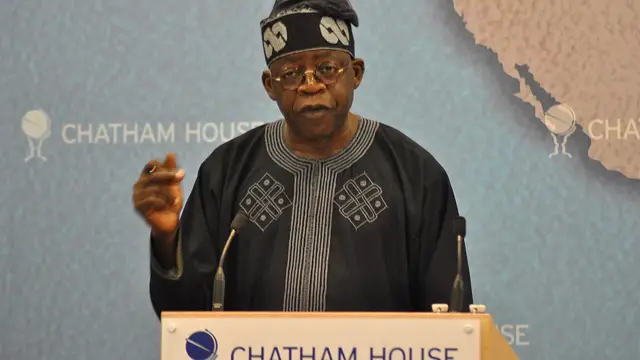
President Tinubu Rejects Fuel Subsidy Reinstatement, Citing Economic Risks
President Bola Tinubu reiterated his refusal to restore Nigeria’s petrol subsidy, arguing that doing so would damage the economy and raise fuel prices, while Finance Minister Taiwo Oyedele warned of capital flight and a weaker naira.
Photo: Chatham House / Wikimedia Commons · CC BY 2.0
LAS News Desk · 20 Oct 2026, 06:15 WAT · 2 sources
More Africa/Nigeria news ›
- NDC unveils presidential campaign council amid internal backlash from OK Movement
- Atiku aide seeks clarification on seven SUVs displayed by APC youth chief
- Nigerian troops arrest man in military uniform for phone snatching in Plateau State
- Chief Justice warns Nigerian judges to avoid pressure and forum shopping before 2027 elections
- Burna Boy and Yseult headline NFL Paris Game halftime, showcasing Afrobeats at Stade de France