
Naira falls to N1,367.61 per dollar as currency extends decline
The Nigerian Naira weakened further against the US dollar on Monday, dropping to N1,367.61 at the official rate despite a recent increase in the country's external reserves.
By LAS News Desk · Published 27 Oct 2026, 00:00 WAT

The Nigerian Naira experienced a continued decline against the United States dollar as foreign exchange trading resumed on Monday, October 26, 2026. According to data released by the Central Bank of Nigeria (CBN), the official exchange rate weakened to N1,367.61 per dollar. This represents a drop from the previous closing rate of N1,361.84 recorded at the end of trading on Friday, October 23.
The depreciation amounted to a loss of N5.77 per dollar at the official foreign exchange market compared to the previous week's close. The downward trend was not limited to the official sector; the parallel market also saw the Naira weaken. In the unofficial market, the currency fell by N10, reaching a rate of N1,385 per dollar, down from N1,375 recorded in the previous week. This simultaneous weakening across both market segments highlights persistent pressure on the currency despite recent developments in the country's financial reserves.
Background
The recent decline in the Naira's value follows a period of significant volatility in the foreign exchange markets. Reports indicate that the currency had already suffered a sharp drop from Thursday to Friday of the previous week, losing N22.12 per dollar during that two-day span. This prior loss set the stage for the further depreciation observed on Monday.
Notably, the recent weakening of the Naira occurred despite a positive development in Nigeria's external reserves. Data showed that the country's external reserves rose to $55.18 billion on Friday. Typically, an increase in foreign reserves can provide support to a currency by indicating a stronger capacity to meet external obligations and import needs. However, in this instance, the rise in reserves did not prevent the Naira from continuing its downward trajectory against the dollar.
The Central Bank of Nigeria serves as the primary source for the official exchange rate data, which is used for government transactions and regulated commercial activities. The parallel market rate, while not officially sanctioned, often reflects the true market sentiment and supply-demand dynamics for foreign currency among individuals and private businesses. The gap between the official rate of N1,367.61 and the parallel rate of N1,385 suggests a continued premium for dollars in the unofficial sector.
Why it matters
The continued depreciation of the Naira has direct implications for the Nigerian economy and its citizens. A weaker currency increases the cost of importing goods, which can lead to higher prices for essential items such as food, fuel, and pharmaceuticals. This inflationary pressure affects the purchasing power of consumers and the operational costs for businesses that rely on imported raw materials or finished products.
The fact that the Naira fell despite the increase in external reserves to $55.18 billion raises questions about the factors driving the currency's weakness. It suggests that market confidence and other economic variables may be exerting a stronger influence on the exchange rate than reserve levels alone. For investors and businesses, this volatility complicates financial planning and risk management. The disparity between the official and parallel market rates also indicates ongoing challenges in unifying the foreign exchange market, a goal that has been a focus of recent economic reforms in Nigeria.
What happens next
The sources do not provide specific information regarding upcoming policy decisions, scheduled interventions by the Central Bank, or future dates for exchange rate reviews. The next steps for the Naira's value will likely depend on broader economic indicators, global market trends, and any future announcements from the Central Bank of Nigeria regarding monetary policy or foreign exchange management strategies.
Sources
Spotted an error? Report a correction · Corrections policy
Related stories
Nigerian naira hovers around 1,330 per dollar as official rate steadies, parallel market remains higher
The official Nigerian foreign exchange rate stayed near ₦1,332 per US dollar on 20 October 2026, while the unofficial market continued to quote premiums above that level, reflecting ongoing pressure on the naira.
LAS News Desk · 20 Oct 2026, 06:46 WAT · 2 sources

Naira falls to N1,361.84 per dollar as external reserves total $55.16bn
The naira weakened by N27.12 to N1,361.84 per US dollar over two days, despite Nigeria’s central bank reporting $55.16bn in external reserves, according to data released on 25 October 2026.
LAS News Desk · 25 Oct 2026, 12:15 WAT · 1 source
Nigeria's headline inflation eases to 14.6% in September as energy costs jump
The National Bureau of Statistics reported a fall in overall inflation to 14.63% in September 2026, the fourth consecutive monthly decline, while energy inflation more than doubled to 10.85% and food prices remained high.
LAS News Desk · 15 Oct 2026, 19:15 WAT · 10 sources
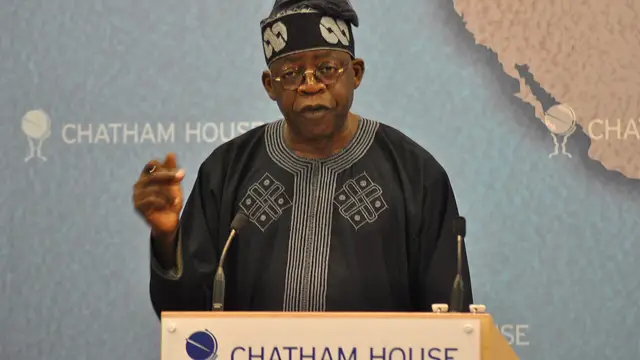
Oyo Governor Makinde criticises Tinubu’s foreign‑reserve narrative, calls for comprehensive reset ahead of 2027 elections
Oyo State Governor Seyi Makinde told President Bola Tinubu that rising foreign‑reserve figures do not alleviate hunger, urging a reset of the economy, security, education and political system as the 2027 elections approach.
Photo: Chatham House / Wikimedia Commons · CC BY 2.0
LAS News Desk · 25 Oct 2026, 03:45 WAT · 6 sources
Tinubu blames opposition for Nigeria's hunger and poverty as Atiku calls claim delusional
President Bola Tinubu accused opposition parties of causing hunger and poverty at an APC rally in Kaduna, while former Vice President Atiku Abubakar denounced the remark as delusional and defended the government's record ahead of the 2027 election.
Photo: Chatham House / Wikimedia Commons · CC BY 2.0
LAS News Desk · 25 Oct 2026, 00:45 WAT · 9 sources

Vice President Kashim Shettima criticises ADC candidate Atiku Abubakar over health knowledge and subsidy policy at Abuja summit
At the 32nd Nigerian Economic Summit in Abuja, Vice President Kashim Shettima accused ADC presidential hopeful Atiku Abubakar of lacking the expertise to run a modern economy and of confusing Ebola with the flu, while defending President Bola Tinubu’s removal of the fuel subsidy.
LAS News Desk · 27 Oct 2026, 00:00 WAT · 2 sources
More Africa/Nigeria news ›
- Wike-backed PDP rejects Tinubu's claim that opposition caused national hardship
- ADC challenges APC’s two‑million vote claim for Tinubu in Jigawa
- Omoyele Sowore criticises NDC’s security appointment, revives Lekki shooting debate
- Kano State Assembly confirms six governor‑nominated commissioners amid political realignment
- Supreme Court Strikes Down Electoral Act Sections on Party Membership Registers