
FCC authorises SpaceX to launch up to one million AI‑chip satellites despite industry objections
The US Federal Communications Commission approved SpaceX’s Starmind plan to place up to one million orbital data‑center satellites, a move contested by Amazon, Viasat, the American Astronomical Society and other observers.
By LAS News Desk · Published 26 Nov 2026, 09:31 WAT
SpaceX has received formal authorisation from the US Federal Communications Commission (FCC) to deploy as many as one million satellites equipped with artificial‑intelligence computing chips. The approval, announced on Wednesday by FCC Chairman Brendan Carr, pertains to the company’s “Starmind” constellation, which the agency says will use solar power to bolster America’s lead in AI technology.
Chairman Carr posted the news on the social platform X, noting that both Starmind and competing constellations would rely on solar energy. Elon Musk responded on the same platform, thanking the commission and describing the approval as a significant asset for the United States and the world.
This ruling comes after an extended phase for public feedback, during which a large volume of remarks was collected. Petitions to deny the application were filed by Amazon’s Kuiper Systems LLC, Viasat Inc., and the American Astronomical Society (AAS). Amazon, which is creating a proprietary satellite connectivity service to compete with SpaceX’s Starlink, described the Starmind initiative as an idealistic goal rather than a concrete strategy, and contended that constructing the suggested network would require centuries for SpaceX.
Background
SpaceX’s proposal centres on launching a massive fleet of low‑Earth‑orbit satellites that would function as data centres for AI workloads, a concept that has emerged alongside similar ambitions from other technology firms. Google announced a “Project Suncatcher” last year, describing it as a moonshot to place AI in space, and has already sent its first chips to orbit on a SpaceX launch and a Planet Labs satellite in October.
Blue Origin, founded by Jeff Bezos, submitted a petition in March to the FCC seeking permission for up to 51,600 satellites under its “Project Sunrise” programme, intended to complement the company’s planned TeraWave internet service.
The FCC’s filing notes that the Starmind application attracted opposition from industry players and scientific bodies. Amazon’s petition, filed in March, highlighted a lack of detailed implementation plans and questioned the feasibility of constructing such a large constellation within a reasonable timeframe. The American Astronomical Society also expressed concerns, though the specific content of its comments was not disclosed.
Why it matters
If realised, the Starmind constellation could reshape the infrastructure supporting AI by moving compute resources into space, potentially reducing latency for global AI services and expanding the United States’ strategic advantage in the sector. Proponents argue that solar‑powered satellites could provide a continuous, high‑capacity platform for AI processing without the constraints of terrestrial data‑centre energy consumption.
Critics, however, warn of several risks. Amazon and Viasat contend that the scale of the project is unrealistic and that SpaceX has offered limited technical detail on deployment schedules, satellite design, and data‑handling protocols. Astronomical societies have raised the prospect of increased orbital congestion, which could exacerbate the risk of collisions and generate additional space‑debris hazards.
The approval also signals a regulatory shift, as the FCC moves to endorse commercial AI‑in‑space initiatives despite unresolved safety and feasibility questions. The decision may influence future policy on satellite constellations, prompting other firms to seek similar authorisations while potentially prompting tighter scrutiny from international space governance bodies.
What happens next
Following the FCC’s sign‑off, SpaceX is expected to begin detailed planning for the Starmind launch sequence, though no specific timetable has been disclosed. The company will need to address the concerns raised by Amazon, Viasat and the AAS, likely through further technical submissions and coordination with other satellite operators to mitigate collision risks.
Amazon’s Kuiper Systems has reiterated its own deployment goals, suggesting that competition will intensify as both firms advance their respective satellite constellations. Blue Origin’s petition for Project Sunrise remains pending, and the outcome may depend on how the FCC evaluates the cumulative impact of multiple large‑scale constellations on orbital traffic.
Stakeholders, including scientific organisations and industry observers, will be monitoring SpaceX’s progress closely, particularly any updates on satellite design, launch cadence and mitigation strategies for space‑debris management.
Sources
- FCC says SpaceX can deploy 1 million satellites for data centers in space. Scientists are skeptical — NPR
- SpaceX wins FCC approval to deploy 1 million orbital data center satellites — CNBC
- SpaceX wins U.S. government approval to launch space data centers — Japan Times
- FCC signs off on SpaceX’s plan to put up to 1 million data center satellites into space — The Verge
Spotted an error? · Corrections policy
Related stories

Democrats’ 2026 midterm win fuels anti‑AI sentiment and pushes for datacenter moratoriums across the US
The 2026 midterm elections saw Democrats defeat Republican‑backed AI industry allies, leading to local bans on new datacenters in over 30 jurisdictions and signalling a shift toward anti‑AI populism ahead of the 2028 cycle.
LAS News Desk · 9 Nov 2026, 12:39 WAT · 1 source
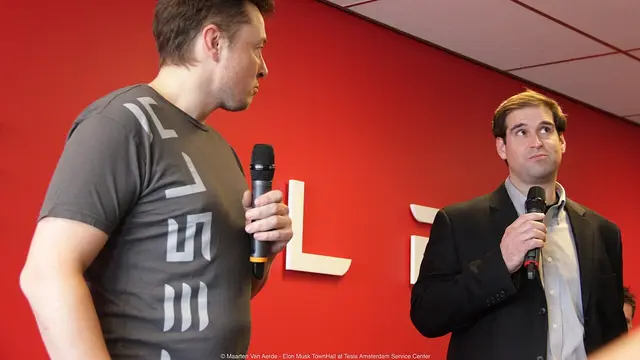
Elon Musk pledges two SpaceX shares for every child in the United States, a donation valued at nearly $18 billion
Musk announced on X that each U.S. child will receive one SpaceX share from the company and a matching share from him personally, with the company’s portion to be transferred in December and his personal share in June 2027.
Photo: Tesla Owners Club Belgium / Wikimedia Commons · CC BY 2.0
LAS News Desk · 26 Nov 2026, 10:30 WAT · 5 sources
NATO pledges defence of space after German reports of Russian nuclear‑armed satellite plan
NATO Secretary‑General Mark Rutte said the alliance will protect its territory, including space, following German media reports that Russia may launch a nuclear‑armed satellite called Sputnik‑S in the coming weeks. The Kremlin dismissed the claims as unfounded.
LAS News Desk · 23 Nov 2026, 23:46 WAT · 4 sources

Anthropic's US IPO values firm at $1.5tn as founders set to become multi‑billionaires
Anthropic, the AI firm behind Claude, launched a record‑breaking US stock market debut, raising $81bn and valuing the five‑year‑old company at around $1.5tn, with its seven founders poised to hold shares worth over $19bn each.
LAS News Desk · 19 Nov 2026, 19:12 WAT · 2 sources
Iowa to detonate five tonnes of lead azide after court clearance
The U.S. Army will carry out a controlled detonation of 68 drums of degraded lead azide at the Iowa Army Ammunition Plant following an 8th Circuit Court ruling, after President Trump paused the operation pending court and governor approval.
LAS News Desk · 24 Nov 2026, 15:16 WAT · 3 sources

US midterm elections trigger global tech sell‑off as AI scrutiny fears spread
IMF Managing Director Kristalina Georgieva stated that central banks must consider a potential slowdown in AI-driven growth amid rising inflation and market volatility following a global tech sell-off triggered by US midterm election results.
LAS News Desk · 16 Nov 2026, 07:43 WAT · 3 sources
More Business news ›
- Nvidia shares jump over 30% after Jensen Huang reinstated as CEO
- Alex Spiro and Tom Brady consider minority stakes in Chelsea as Clearlake seeks new investors
- Jensen Huang to give first public Senate testimony on spy allegations
- UK energy price cap set to rise 26% in January, adding £443 to average household bills
- Nvidia creates board‑level National Security and Export Control Oversight Committee after CEO resignation