
Emir of Kano praises Tinubu’s economic turnaround while urging continued reforms
Emir Muhammadu Sanusi II acknowledged President Bola Tinubu’s role in stabilising Nigeria’s economy, citing higher growth, lower inflation and larger reserves, but warned that persistent challenges require sustained policy and better public engagement.
By LAS News Desk · Published 4 Nov 2026, 10:24 WAT
Emir of Kano Muhammadu Sanusi II addressed the Oxford Global Think Tank conference on 3 November 2026, offering a mixed assessment of President Bola Tinubu’s economic stewardship. Speaking alongside former World Bank Vice‑President Arunma Oteh, Sanusi praised the administration for pulling the country back from a near‑collapse scenario he had warned about in 2023, while also urging the government to listen more to public concerns about poverty and to improve its communication style.
Sanusi highlighted several macro‑economic indicators that, in his view, demonstrate a turnaround. He noted that Nigeria’s gross domestic product grew by 4.48 % in the second quarter of 2026, a marked improvement over the 0.9 % average growth recorded during former President Muhammadu Buhari’s tenure. Inflation, he said, had fallen from roughly 30 % to 14.6 %, with projections of a further decline to 12.5 % by year‑end. He also pointed to a 47 % rise in GDP per‑capita (in dollar terms) since 2023 and a foreign‑reserve balance of about $55 billion, albeit largely supported by volatile portfolio inflows.
Background
Sanusi, a former governor of the Central Bank of Nigeria, first warned in 2023 that the nation was on the brink of hyperinflation and economic collapse. Those warnings resurfaced during his remarks at the Oxford Global Think Tank, where he reiterated that the country had narrowly avoided a crisis. The conference, convened by Arunma Oteh, provided a platform for Sanusi to contrast the current administration’s performance with earlier periods, citing the Buhari years as a low‑growth era and noting that the current growth, while not matching the Yar’Adua‑Jonathan era, represented significant progress.
He also referenced the Dangote Refinery, which now accounts for about 20 % of Nigeria’s exports, as evidence of diversification beyond traditional oil shipments. Sanusi attributed part of the foreign‑reserve build‑up to high oil prices linked to tensions in the Strait of Hormuz and to attractive returns for investors.
Why it matters
The emir’s comments carry weight given his former role at the CBN and his status as a traditional ruler. By acknowledging Tinubu’s credit for economic gains, Sanusi lends political legitimacy to the administration’s policies, which have faced criticism over fuel subsidy removal, currency devaluation and rising living costs since mid‑2023. At the same time, his call for the government to engage more constructively with citizens highlights ongoing public discontent, especially among households struggling with the cost of living.
Sanusi warned that the government’s tendency to label criticism as hostility could undermine trust. He argued that constructive suggestions should be distinguished from attacks, and that better spokespersons are needed to convey policy intentions. The emphasis on sustaining growth is crucial; Sanusi suggested that maintaining the current trajectory could restore GDP per‑capita to its 2005 level by the end of the following year, a benchmark that could influence voter sentiment ahead of the 2027 elections.
What happens next
Sanusi’s remarks did not outline specific policy actions but underscored the need for continued fiscal discipline and communication reforms. He indicated that the projected inflation decline to 12.5 % by year‑end and the potential return of GDP per‑capita to 2005 levels by the end of next year are contingent on maintaining the present growth rate. Observers will likely monitor the Tinubu administration’s response to the emir’s critique, particularly any adjustments in public outreach or economic policy aimed at consolidating the gains highlighted at the conference.
The divergent tones in Sanusi’s statements—praise for economic recovery coupled with criticism of governmental communication—reflect a nuanced view that may shape both domestic debate and international perception of Nigeria’s economic outlook.
Sources
Spotted an error? Report a correction · Corrections policy
Related stories
Former Osun lawmaker urges support for President Tinubu amid Nigeria's economic hardship
Olatunbosun Oyintiloye, a former Osun State legislator and APC chieftain, called on Nigerians and opposition politicians to back President Bola Tinubu instead of criticising his handling of the economy, citing recent reforms and the upcoming 2027 election.
LAS News Desk · 25 Oct 2026, 13:15 WAT · 2 sources
Tinubu blames opposition for Nigeria's hunger and poverty as Atiku calls claim delusional
President Bola Tinubu accused opposition parties of causing hunger and poverty at an APC rally in Kaduna, while former Vice President Atiku Abubakar denounced the remark as delusional and defended the government's record ahead of the 2027 election.
Photo: Chatham House / Wikimedia Commons · CC BY 2.0
LAS News Desk · 25 Oct 2026, 00:45 WAT · 9 sources
President Tinubu Rejects Fuel Subsidy Reinstatement, Citing Economic Risks
Nigerian President Bola Tinubu has declared that the removal of the fuel subsidy is irreversible, while Finance Minister Taiwo Oyedele warned that reinstating it could push the dollar to N3,000 and petrol to N5,000 per litre.
Photo: Chatham House / Wikimedia Commons · CC BY 2.0
LAS News Desk · 31 Oct 2026, 22:46 WAT · 2 sources
Wike links Nigeria’s economic recovery to Tinubu reforms amid political tensions
Federal Capital Territory minister Nyesom Wike argued that sustaining President Tinubu’s reform agenda is essential for Nigeria’s recovery, while former presidential aide Laolu Akande suggested his political survival is tied to the APC’s 2027 election strategy.
LAS News Desk · 17 Oct 2026, 19:15 WAT · 2 sources
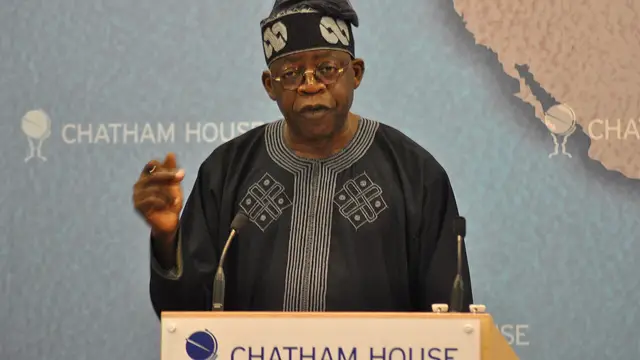
Tinubu seeks Senate approval for $20.5bn external borrowing to cover funding gaps
President Bola Tinubu has requested the Nigerian Senate to approve over $20 billion in external loans to address deficits in the 2026-2027 supplementary borrowing plan, a move criticized by opposition figures.
Photo: Chatham House / Wikimedia Commons · CC BY 2.0
LAS News Desk · 28 Oct 2026, 08:17 WAT · 1 source
Nigerian Finance Minister admits households spend 120% of income on food
Taiwo Oyedele stated at Chatham House that soaring food prices force many Nigerians to borrow money, with food inflation outpacing headline inflation.
LAS News Desk · 27 Oct 2026, 10:46 WAT · 2 sources
More Africa/Nigeria news ›
- Education Minister Alausa Defends Tinubu’s Academic Record, Calls President a Genius
- Education Minister Alausa predicts Tinubu’s 2027 re‑election on record of reforms
- Bayelsa Governor Douye Diri tables ₦1.24 trillion 2027 budget with 68% earmarked for capital projects
- South Africans cast votes in municipal elections amid mounting frustration over services and ANC decline
- Akwa Ibom appoints 4,000 new civil servants to address vacancies, governor says