
UK student visa changes trigger wave of Nigerian application withdrawals
New UK immigration rules raising financial thresholds and cutting post-study work rights have led universities to withdraw offers, particularly affecting applicants from Nigeria and Pakistan.
By LAS News Desk · Published 25 Oct 2026, 06:17 WAT
The United Kingdom has introduced a series of stricter immigration policies targeting international students, resulting in a significant increase in application withdrawals, particularly from Nigeria. The new measures aim to tighten control over foreign student admissions and post-graduation residency, a shift that has been interpreted by many potential applicants as a signal that the UK is less welcoming to international enrollees. These changes take effect in stages, with key financial requirements becoming stricter from November 30, 2026, and post-study work rights being reduced starting in January 2027.
Under the revised rules, students must demonstrate higher monthly maintenance funds to prove they can support themselves during their studies. From the end of November 2026, the required amount will rise to £1,570 per month for students studying in London and £1,203 per month for those studying elsewhere in the UK. Additionally, the period during which graduates can remain in the country to seek employment has been cut from two years to 18 months. These adjustments are part of a broader strategy that includes stricter compliance rules for educational institutions and higher tuition thresholds for undergraduate courses.
Background
The current policy framework builds upon restrictions introduced in 2024, which already limited the ability of most taught Master’s students to bring family members to the UK. The recent updates add financial hurdles and compliance pressures that have altered the landscape for international recruitment. A critical component of the new regime is the enforcement of compliance standards for universities. Institutions now face severe risks to their operating licences if their student visa refusal rates exceed five percent. This regulatory pressure has prompted several UK universities to implement rigorous pre-screening processes. As a result, many institutions have proactively withdrawn admission offers from applicants in regions with historically higher refusal rates, with Nigeria being prominently affected by this trend. The policy also includes a 32 percent increase in the Immigration Skills Charge for employers, further complicating the pathway for international talent.
Why it matters
The new policies have created significant disappointment among prospective students, their parents, and sponsors. For many families, particularly in Nigeria, sending a child to study in the UK involves substantial financial investment, often with the expectation that the graduate will secure employment and residency in the country, thereby providing a return on investment. The reduction in post-study work rights and the increased difficulty in securing visas have undermined this expectation. Parents and sponsors report that the guarantee of a favorable outcome for their financial outlay is no longer present. The rise in application withdrawals indicates that the stricter pre-screening by universities is effectively filtering out a larger proportion of applicants before they even apply for visas, leading to wasted effort and resources for both students and institutions. The policy is seen as making it difficult for foreign students to secure admission despite their ability to pay high tuition fees, as financial capacity alone no longer guarantees entry.
What happens next
The stricter maintenance fund requirements will come into force on November 30, 2026. Following this, the reduction in post-study work rights to 18 months will take effect in January 2027. In the interim, UK universities are expected to continue enforcing their enhanced pre-screening protocols to manage their visa refusal rates and protect their licences. Analysts, including public affairs expert Samuel Ugwumsinachi, have urged the Nigerian federal government to take steps to protect the interests of its citizens in light of these developments. The ongoing implementation of these rules will likely continue to impact application numbers and the demographic composition of international student cohorts in the UK.
Sources
Spotted an error? Report a correction · Corrections policy
Related stories

Peter Obi urges UK‑based Nigerians to halt remittances and promote voting for accountable leaders
At a Manchester town‑hall meeting, Nigeria Democratic Congress presidential candidate Peter Obi called on Nigerians living in Britain to stop sending money to relatives at home, arguing that remittances enable poor governance and urging them to push for better leadership in the 2027 election.
LAS News Desk · 19 Oct 2026, 17:45 WAT · 8 sources
US Mission in Nigeria Confirms Visa Fees Are Non‑Refundable, Warns Against Fraudulent Schemes
The United States Mission in Nigeria used its official X account to reiterate that visa application fees are not refundable, regardless of approval or refusal, and advised applicants to rely on official government sources and avoid third‑party scams.
LAS News Desk · 14 Oct 2026, 18:16 WAT · 4 sources
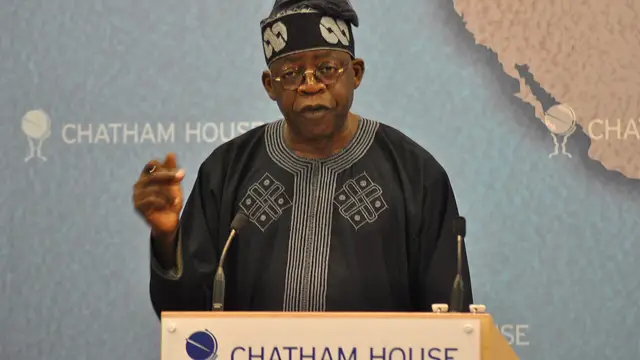
Oyo Governor Makinde criticises Tinubu’s foreign‑reserve narrative, calls for comprehensive reset ahead of 2027 elections
Oyo State Governor Seyi Makinde told President Bola Tinubu that rising foreign‑reserve figures do not alleviate hunger, urging a reset of the economy, security, education and political system as the 2027 elections approach.
Photo: Chatham House / Wikimedia Commons · CC BY 2.0
LAS News Desk · 25 Oct 2026, 03:45 WAT · 6 sources

Katsina United rally to 2-2 draw with Plateau United in NPFL matchday 10
Katsina United overturned a two‑goal deficit to secure a 2-2 draw against Plateau United at Muhammadu Dikko Stadium, with late goals from Yusha’u Armiya’u and Umar Rabiu. The result leaves the hosts in 12th place and the visitors in fourth.
LAS News Desk · 25 Oct 2026, 00:45 WAT · 2 sources

First Lady Urges Nigerians to ‘See Progress’ with ‘Tinubu Eyeglasses’
Oluremi Tinubu told supporters in Abuja that citizens who do not notice the country’s improvements need special ‘Bola Tinubu eyeglasses’, citing airport upgrades as evidence of progress. The remark came as the president’s administration faces criticism over rising living costs.
LAS News Desk · 24 Oct 2026, 21:16 WAT · 2 sources

Senate rejects NMDPRA petrol import figures, summons NNPCL and NEITI
The Senate Committee on Public Accounts has rejected the Nigerian Midstream and Downstream Petroleum Regulatory Authority’s 2022‑23 petrol import figures, citing large differences with the Nigerian National Petroleum Company Limited’s records, and has ordered a joint meeting with the agencies to resolve the discrepancies.
LAS News Desk · 21 Oct 2026, 23:15 WAT · 2 sources
More Africa/Nigeria news ›
- Edo Police Launch Probe into Alleged Attack on Entertainer MC Porcupine in Benin City
- CAF names Media Experts and MBS as free‑to‑air partners for AFCON 2027
- ADC chieftain Kenneth Okonkwo labels Tinubu administration a government of anarchy
- AAC candidate Sowore criticises Tinubu over Kaduna campaign crowd size
- Arewa Forum Calls for Transparency on Nigeria’s $700bn US Mineral Deal